


WhaleTelecom
Prevent whale-ship collisions using submarine cables
The WhaleTelecom projet
CONTEXT AND MAIN ISSUES
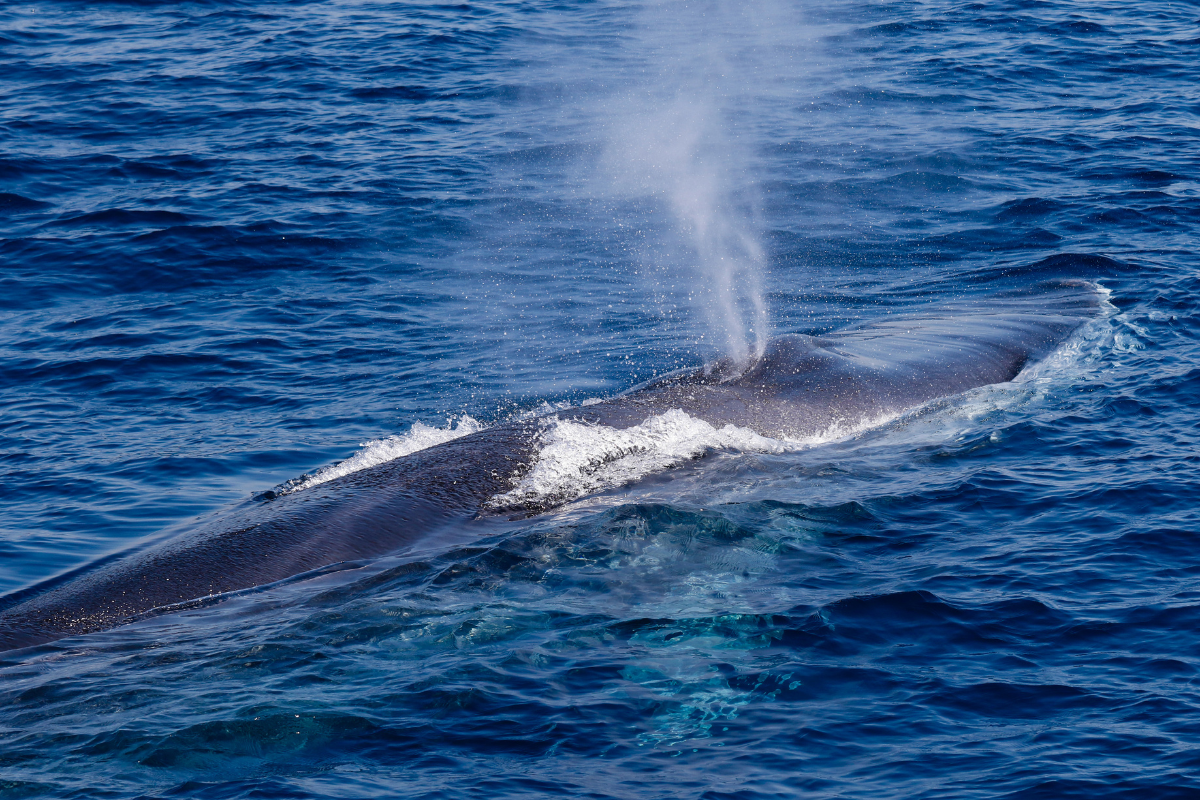
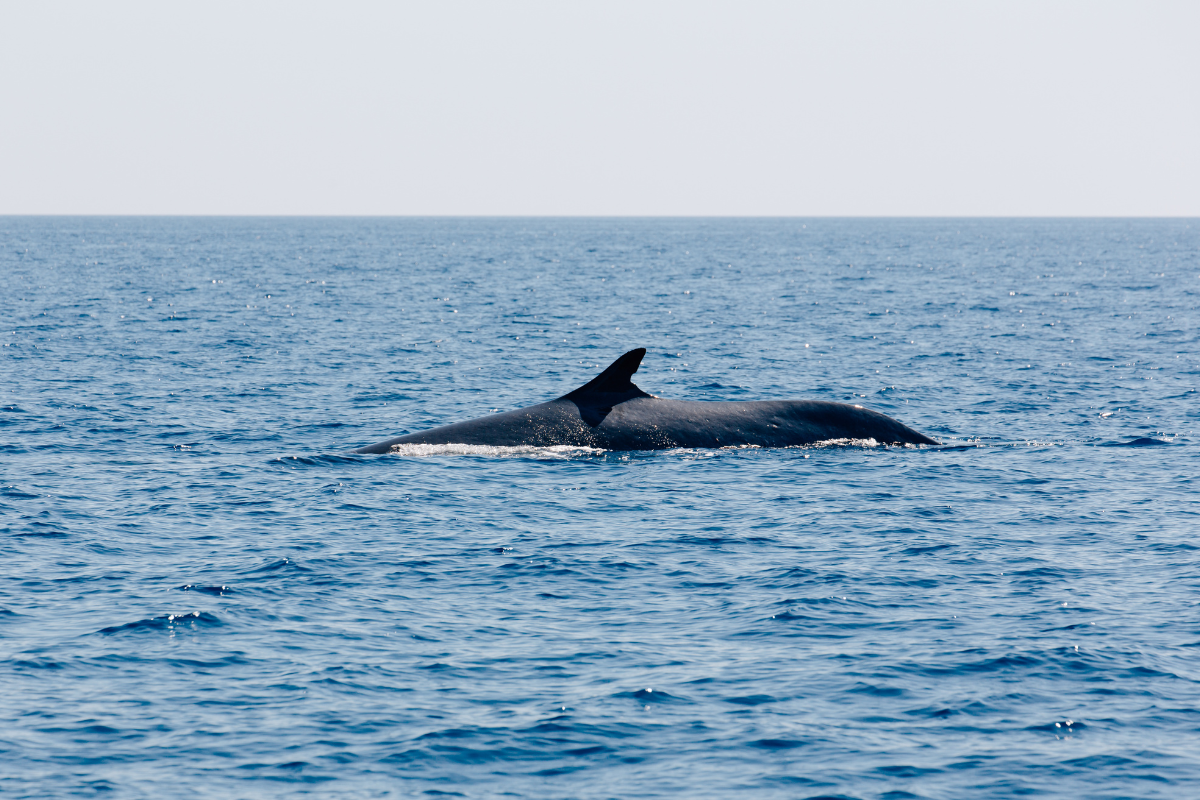
The fin whale (Balaenoptera physalus), listed as Endangered by the International Union for Conservation of Nature (IUCN), is the largest cetacean present in the Mediterranean and the second‑largest animal on Earth. In this basin, the fin whale population is severely threatened by collisions with ships, identified as one of the leading causes of mortality in one of the world’s busiest maritime regions.
Risks are particularly high in the western Mediterranean, notably in the Pelagos Sanctuary, the Gulf of Lion and the Strait of Gibraltar, where major shipping routes overlap with fin whale habitats. While some high‑risk areas are known, large regions remain poorly documented, and interactions between whales and vessels are still insufficiently understood.
Three major factors currently limit effective protection: the lack of continuous data on fin whale presence, limited knowledge of their behavioural responses to vessels, and the absence of real‑time warning systems capable of preventing collisions.
Improving coexistence between maritime transport and large cetaceans is therefore a critical issue for protecting the Mediterranean fin whale and, more broadly, cetaceans across the global ocean.
GOALS
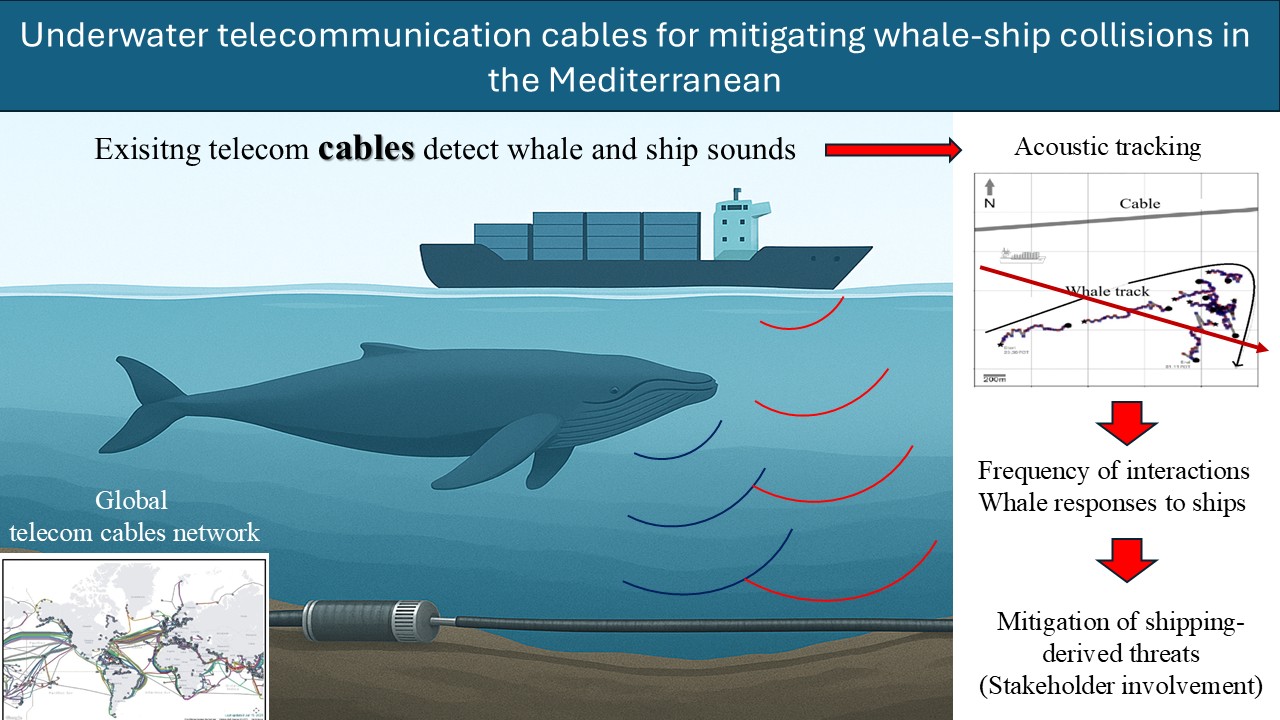
To measure interactions between cetaceans and maritime traffic through innovative acoustic monitoring of their calls, using submarine fibre‑optic cable networks.
METHOD
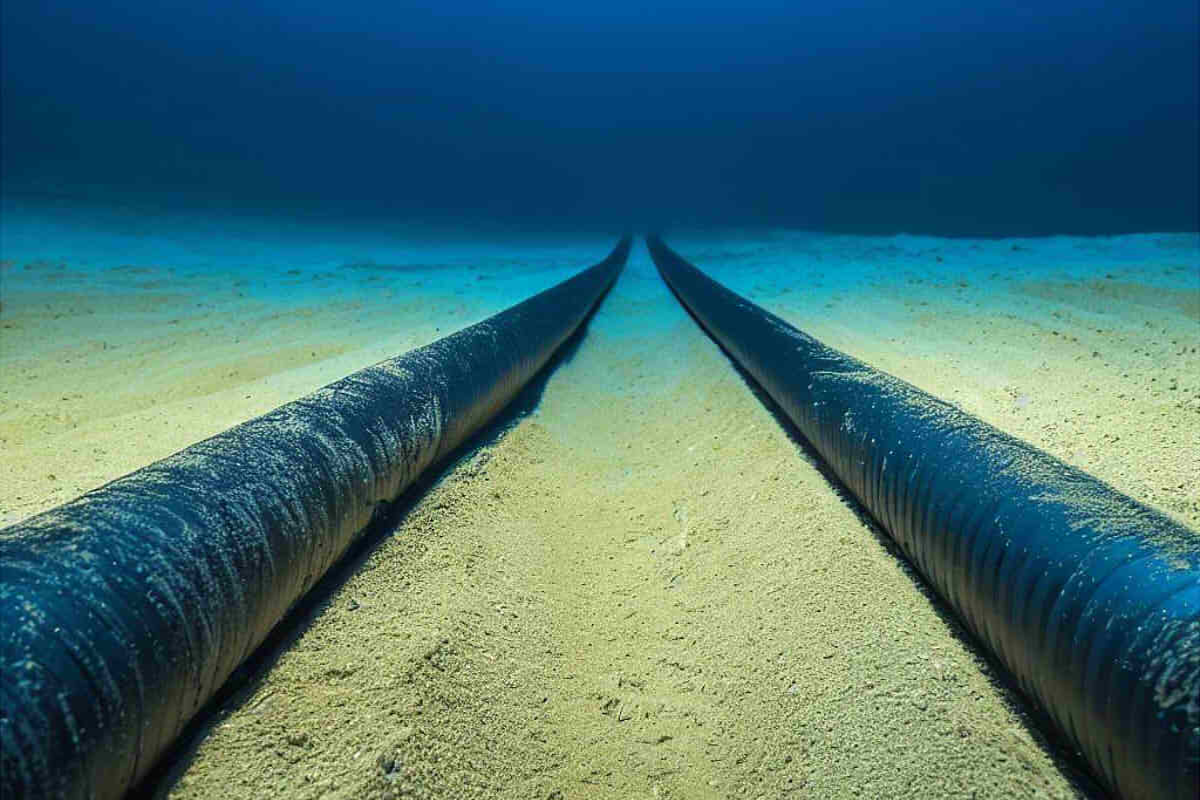
The WhaleTelecom project relies on an innovative, non‑invasive technology: Distributed Acoustic Sensing (DAS) applied to submarine fibre‑optic cables
Telecommunication cables already deployed on the ocean floor are repurposed as long‑range acoustic sensors, capable of continuously detecting and localising fin whale vocalisations over large distances. This approach allows simultaneous monitoring of whale presence and movements without additional installations in the marine environment.
Acoustic data are combined with maritime traffic data (vessel trajectories, speeds and types) to analyse spatial and temporal overlap between whales and ships and to study whale responses to approaching vessels.
This method provides a precise and continuous view of whale–ship interactions, currently inaccessible using conventional monitoring tools.
HOW IS THIS PROJECT INNOVATIVE?
WhaleTelecom repurposes an existing ocean infrastructure, submarine telecommunication cables, to create a large‑scale ecological monitoring system with no added environmental impact.
Applying Distributed Acoustic Sensing to marine conservation represents a major technological breakthrough, enabling continuous, high‑resolution monitoring of fin whales in heavily trafficked maritime zones.
The project is also innovative in its operational and applied focus: collected data are directly intended for managers and international bodies involved in maritime safety and marine spatial planning.
By laying the scientific and technological groundwork for future alert systems, Whale Telecom opens the way for concrete measures to reduce collisions and strengthen protection of the fin whale, an emblematic and endangered Mediterranean species.
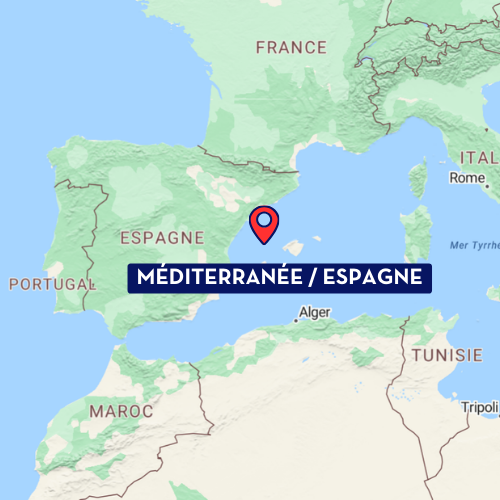
LOCATION
NEWS
Project duration
2026 – 2028
SUSTAINABLE DEVELOPMENT GOALS

Results and advances
Coming soon
Step 1
Lorem ipsum dolor sit amet, consectetur adipiscing elit. Ut elit tellus, luctus nec ullamcorper mattis, pulvinar dapibus leo.
Lorem ipsum dolor sit amet, consectetur adipiscing elit. Ut elit tellus, luctus nec ullamcorper mattis, pulvinar dapibus leo.
étape 2
Lorem ipsum dolor sit amet, consectetur adipiscing elit. Ut elit tellus, luctus nec ullamcorper mattis, pulvinar dapibus leo.
Lorem ipsum dolor sit amet, consectetur adipiscing elit. Ut elit tellus, luctus nec ullamcorper mattis, pulvinar dapibus leo.
étape 3
Lorem ipsum dolor sit amet, consectetur adipiscing elit. Ut elit tellus, luctus nec ullamcorper mattis, pulvinar dapibus leo.
Lorem ipsum dolor sit amet, consectetur adipiscing elit. Ut elit tellus, luctus nec ullamcorper mattis, pulvinar dapibus leo.
The team
Miriam Romagosa Vergés
Postoc researcher at ICM-CSIC
Arantza Ugalde Aguirre
Senior researcher at ICM-CSIC
Joan Navarro Bernabé
Senior researcher at ICM-CSIC
Tony Monfret
Senior researcher at UMR Géoazur (Université de Côté d'Azur)
Partners
Person
Title, organism
Institutional Partners
First name Last name
Université, structure, asso,...
First name Last name
Université, structure, asso,...
First name Last name
Université, structure, asso,...